




How the Recycling Market in the DACH Region Is Structured
The German circular economy is a significant economic factor: around 9,500 municipal and private companies employ approximately 322,000 people, and the private sector generated revenue of around EUR 106 billion. Behind this figure, however, lies not a single uniform market but a web of submarkets along the material streams: metals, plastics, paper, glass, waste electrical and electronic equipment, batteries, construction and demolition waste, and waste wood. Each of these streams follows its own volumes, prices and technical requirements. In Austria and Switzerland, the picture is similar, only more fragmented.
This market is shaped by a small number of large corporate groups and a large number of owner-managed specialists, often in the second or third generation. Their position rests on assets that cannot be built up in the short term: plants with the necessary permits, secured access to input volumes and well-established relationships with regional material sources and offtakers. It is precisely this combination that makes established businesses hard for outsiders to challenge and, at the same time, attractive.
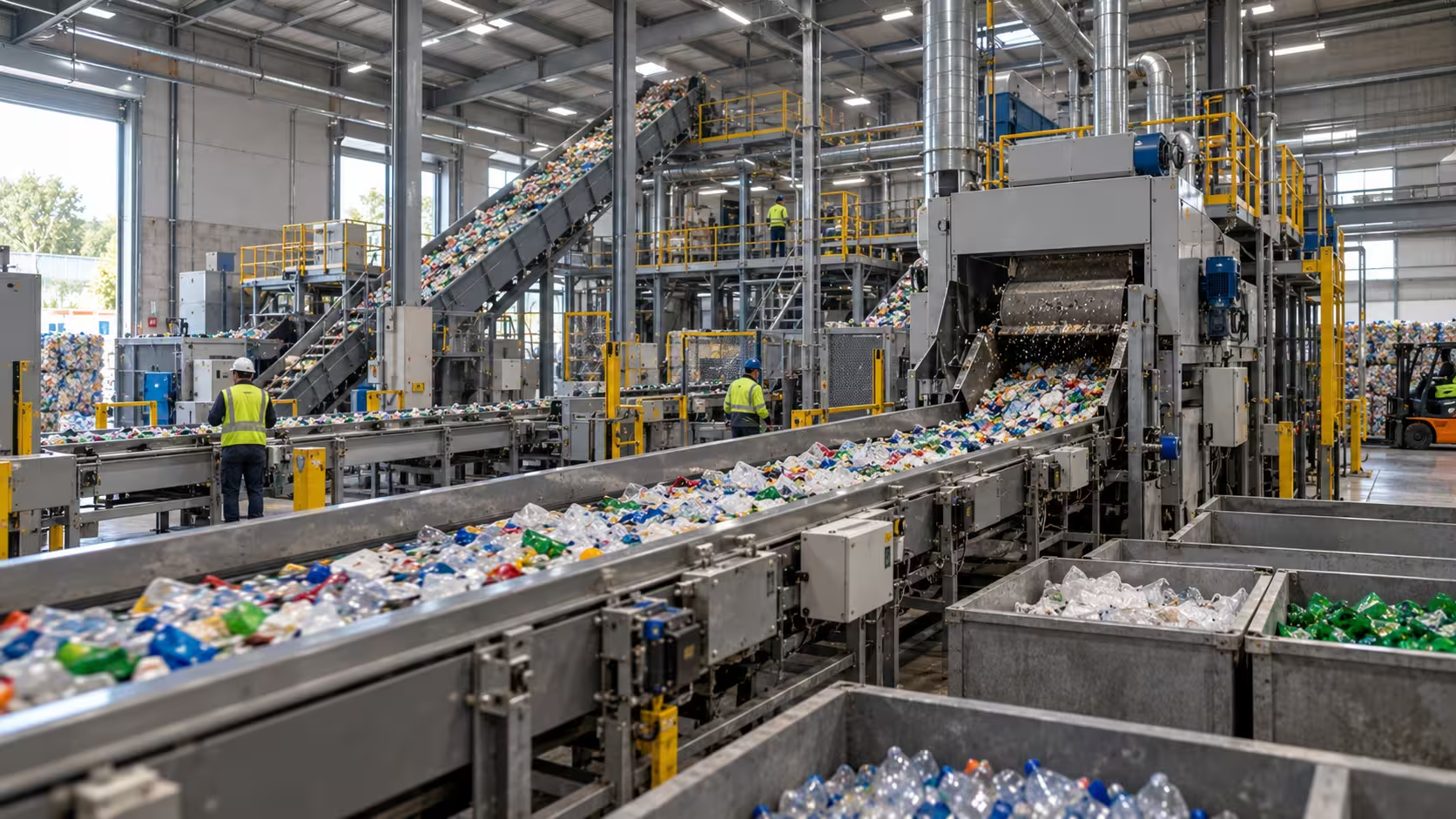
From an M&A perspective, that is, from the perspective of company acquisitions and mergers, the decisive dividing line runs between two business models. On one side are companies that create value in-house through sorting, processing and material recovery. On the other side are pure collection, transport and trading models that move volumes but do not upgrade them. Buyers are primarily interested in specialists within a given material stream who have their own plant technology and a clear market position.
Which Developments Are Structurally Changing the Recycling Market
Independently of any transaction, three developments are changing the fundamentals of the business.
Regulation and recycled content quotas. Binding content quotas already apply: since 2025, single-use PET beverage bottles must contain an average recycled content of 25%. From 2030, the EU Packaging and Packaging Waste Regulation (PPWR) extends this logic to plastic packaging as a whole, with minimum shares of post-consumer recyclate per packaging type of between 10% and 35%, rising to 65% for single-use beverage bottles by 2040. In summer 2026, the EU also adopted binding quotas for plastics in new vehicles: 15% from 2032 and 25% from 2036. Recycling is thus evolving from a disposal service into a source of raw material supply for industry, and the market is tightening: demand for plastic recyclates is expected to exceed supply in Germany and Europe by around 30% by 2030. For a mid-sized business, this means that anyone wishing to act as a reliable recyclate supplier needs capacity, consistent qualities and systems to prove both. This ties up capital.
Raw material security and critical raw materials. With the Critical Raw Materials Act, the EU has stipulated that its recycling capacities should cover at least 25% of annual consumption of strategic raw materials by 2030. Batteries, metals, waste electrical and electronic equipment and urban mining, that is, the recovery of raw materials from existing buildings and products, are thus gaining strategic importance for industry and policymakers. This becomes tangible in the case of batteries, for example: from 2031, minimum shares of recycled cobalt (16%), lithium (6%) and nickel (6%) will apply to new industrial and vehicle batteries, with quotas rising until 2036. For businesses in these streams, permits and plants are becoming strategic assets. At the same time, expectations regarding volumes and availability are growing to a level that a single site can rarely meet on its own.
Technology and quality requirements. Industrial offtakers demand high-quality recyclates with specified properties rather than downcycling. This requires modern, usually sensor-based sorting and processing technology, along with growing verification and documentation obligations regarding the origin, quality and carbon footprint of the streams. Both call for ongoing investment in technology, IT and staff that is increasingly difficult to fund from the operating business of a single site.
Why Consolidation Is Beginning in the Recycling Market
These drivers give rise to a simple mechanism: a fragmented market meets requirements that are increasingly difficult to fulfil at the level of the individual site. Plant investments are reaching magnitudes that individual businesses can only finance with considerable effort. Organic growth runs up against permitting periods of several years, scarce land, a shortage of skilled workers and the capital requirements of modern technology.
Mergers and acquisitions shorten this path. They create faster access to capacities, material streams, regions and technologies. Larger groups can spread investments and central functions such as purchasing, sales, IT and administration across several sites. An important point for context: consolidation does not mean standardisation. Within groups, the name, site-level responsibility and regional roots of the companies can be deliberately preserved, because that is precisely where their value lies.
Transactions in recent years show how concrete this trend has become. Several of them follow a buy-and-build approach: an investor acquires a first company as a platform, that is, as the core of a new group, and expands it through further acquisitions.
- Vidia Equity and PolymerCycle: In 2023, the investment firm Vidia Equity acquired the plastics recycler Best Plastic Management, a specialist in post-industrial plastic waste based near Bremen, in the context of a succession situation. In 2024, PB Solutions and ATP Service & Consulting were added as further companies. The case shows how a specialised standalone business can grow into a group for high-quality recyclates.
- Reconomy and Sudamin Rohstoff: In 2024, Reconomy, an international circular economy specialist, acquired Duisburg-based Sudamin Rohstoff. The company organises the collection of metal-bearing residues from the steel industry across Europe and channels them into the recovery of zinc and other metals. The case shows how international groups deliberately add material streams and value creation stages.
- Auctus Capital Partners and the Urban Mining Group: In 2026, Auctus acquired a majority stake in the Frankfurt-based Blasius Schuster Group and is building the Urban Mining Group on this foundation, a nationwide platform for recycled construction materials and mineral processing. The previous managing director retains a significant stake in the group. The case shows that consolidation has also reached the largest volume stream, construction and demolition materials.
- suscepit and Kunststoff- und Farben-Gesellschaft: In 2025, the investment firm suscepit acquired Kunststoff- und Farben-Gesellschaft, a specialist in the recycling of PMMA and acrylic glass active since 1973, as part of a succession solution. The case shows that even narrow niches find buyers if the specialisation within the material stream is deep enough.
Who Buys Recycling Companies and What Logic They Follow
Strategic buyers and international circular economy groups. Groups such as Reconomy expand their existing business by adding material streams, regions and value creation stages. They buy what they could not build up quickly enough themselves: permits, access to material streams, well-established teams and customer relationships. What matters to them is how well a business complements their own range of services and how robustly it continues to operate after the acquisition.
Financial investors with a buy-and-build approach. Investment firms such as those behind PolymerCycle or the Urban Mining Group aim to consolidate a fragmented market and form a group that can achieve more than the sum of its parts. In doing so, they distinguish between a platform investment, that is, a larger, professionally organised company as the starting point for a group, and an add-on, that is, a smaller, specialised company that is integrated into an existing group. This distinction is relevant for owners because role, influence and pricing logic differ depending on the structure of the deal. We have described how buyer groups in the mid-market generally behave in a separate article: "Business Succession: Family Offices, Private Equity & Strategic Buyers - who is actually buying in the succession market?"
Industrial offtakers. Manufacturers and processors take stakes in recycling companies in order to secure recyclate volumes and access to raw materials over the long term. Their perspective is less about the return on the investment than about securing supply for their own production with documented qualities. What matters to them is the reliability of the output.
Which Recycling Companies Are Particularly Attractive from an M&A Perspective
As different as the buyers are, the characteristics they look for are remarkably similar. It is less a question of absolute size than of the substance and transferability of the business.
In-house value creation and plant technology. Businesses with their own sorting, processing and material recovery are in demand, rather than pure trading. The existing permits act as a barrier to entry that is difficult to replicate.
Position in the material stream. Value arises from demonstrable specialisation, secured access to input volumes and reliable output qualities. A business that combines both, secured input and specified products, is difficult to replace for suppliers and offtakers alike.
Customer structure and offtake relationships. Industrial offtakers with longer contract terms, a diversified customer base rather than a concentration on a few relationships, and customer contacts that do not depend solely on the owner make earnings predictable and therefore easier to value.
Organisation and second management level. The operating business continues to function even when the owner is away for two weeks. Plant management, sales and commercial management are staffed and carry responsibility. For buyers, this is the prerequisite for the company's value surviving the handover.
Every owner can measure their own company against these points long before a process is on the horizon. Where individual criteria are not yet met, it is in most cases possible to work on them in a targeted way, given sufficient lead time.


What This Means for Owners: Selling a Recycling Company, Arranging Succession or Growing
Buyer interest does not create an obligation to sell. Entrepreneurs pursue different goals: continuation within the family, external succession, growth with a partner or a complete sale. In between lies the sale with reinvestment, in which the owner reinvests part of the proceeds in the company or the group and thereby remains involved in its further development. This model is particularly common in buy-and-build structures.
For assessing one's own position, a few sober questions are worth considering: how the next major plant investment is to be financed, whether central functions such as IT, purchasing and documentation can be sustained alone in the long term, whether larger volumes and longer contracts are achievable without a partner, and how important preserving the name, regional identity and operational autonomy would be after a transaction. All of these points are negotiable in a structured sale process, provided they are raised early.
Three statements summarise the situation. The recycling market in the DACH region is structurally attractive but fragmented within each material stream, and regulation as well as industrial demand are raising the requirements for capacity, technology and documentation. Investors and larger groups are therefore specifically seeking specialists with in-house value creation, secured access to material streams and a robust organisation. For the owners of such companies, this creates options for growth, succession and sale that did not exist in this breadth just a few years ago. MIND continuously monitors this development in the Energy and Environment and Chemicals & Plastics sectors. MIND is available at any time for a confidential discussion of strategic options.