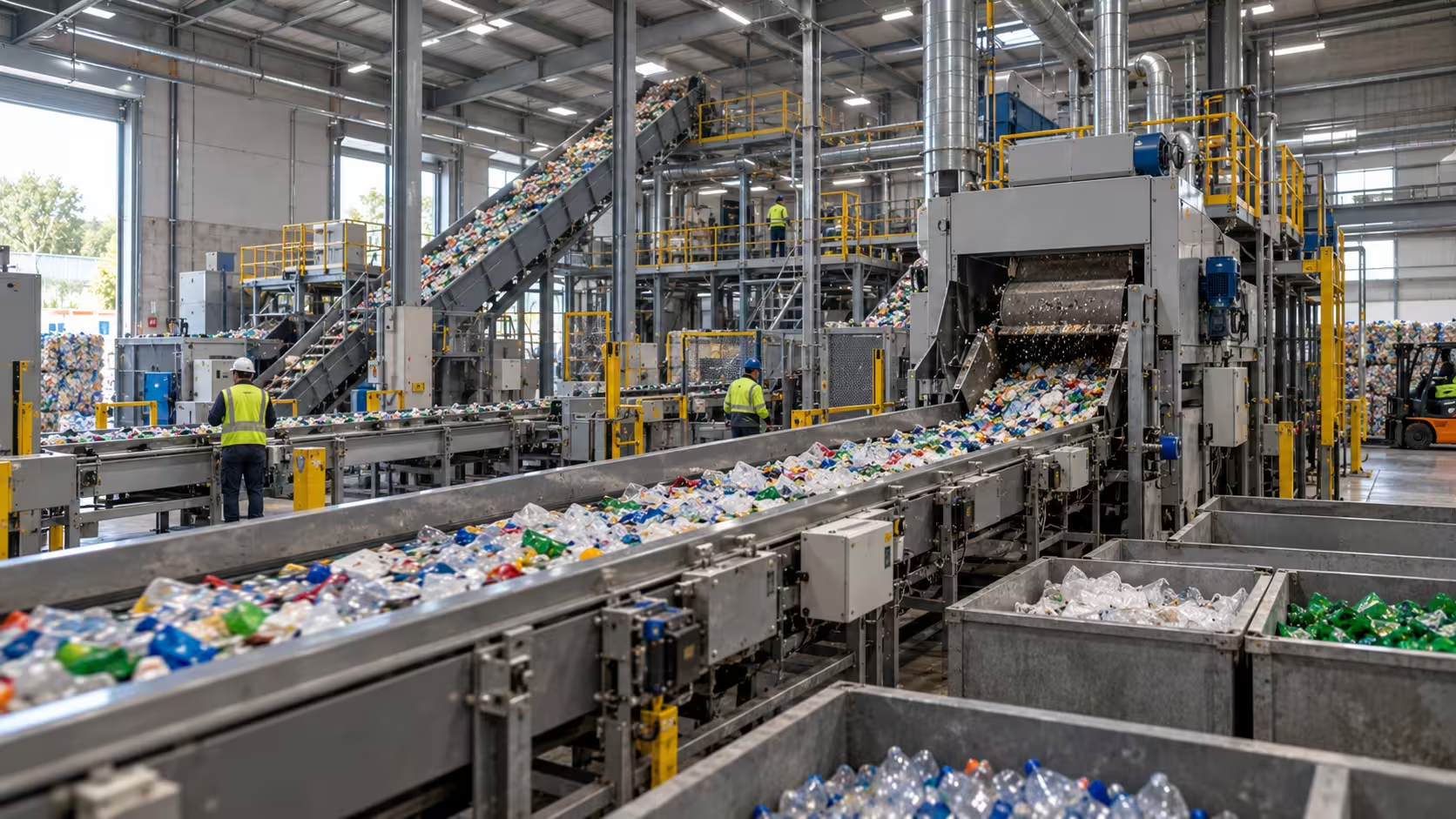


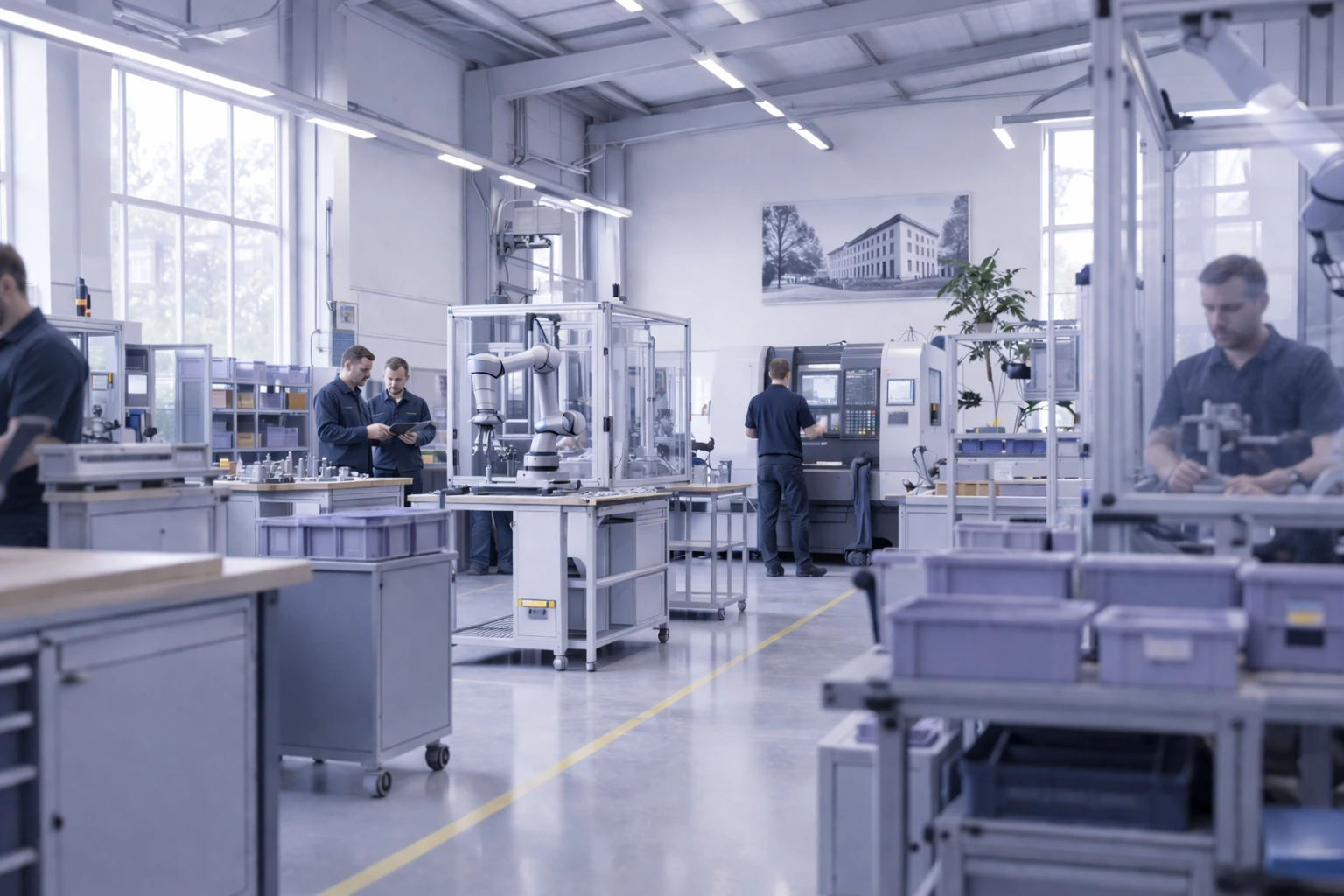



When people in industry talk about robotics, they often still mean the classic industrial robot: precise, fast, well-secured, ideal for highly standardized processes. This image isn't wrong, but it's incomplete. The robotics market in DACH has long since expanded and, above all, is more complex. Robotics today comprises an ecosystem of manufacturers, specialized solution providers, software layers and component suppliers. It is precisely this interplay that is increasingly determining who scales, who defends margins and who becomes an attractive M&A asset.
A look at global development shows how large the base is now: According to industry statistics, around 4.28 million industrial robots worked in factories worldwide in 2023, with annual installations of around 541,000 units. This is no longer “automation as an option,” but is already an industrial norm in many value chains.
At the same time, growth is not only happening where robots have been in use for decades. Professional service robotics is growing dynamically internationally and is particularly heavily supported by transport and logistics applications. This is an important note for DACH, because this raises one of the key strategic questions: Will robotics remain a CAPEX-heavy plant and integration business, or will the market continue to develop into scalable product and software models.
Strategic relevance of robotics in DACH
DACH has a structurally favourable starting position for robotics: a strong industrial base, high quality requirements in production and regulation, and a dense network of mechanical engineering, automotive and supply industries. The fact that Germany is one of the world's leading companies in terms of robot density underlines this industrial roots. For 2023, industry statistics for Germany show 429 robots per 10,000 employees.
The second, often underestimated driver is the labor market. In Germany, the working-age population is shrinking, and shortages of skilled workers are described as a brake on growth. In this situation, automation is not just an issue of efficiency, but also an issue of operational delivery capacity and resilience.
The logic is similar for Austria and Switzerland, albeit with a different industrial weighting. In OECD analyses, Austria is also described as having regional bottlenecks, including in the manufacturing sector. Vacancies in Switzerland fluctuate due to the economy, but the discussion about shortages and productivity remains central. Overall, this strengthens the business case for robotics, particularly where processes are repetitive, safety-critical or difficult to plan.
A third factor is the technological coupling of robotics and AI. European initiatives and industrial clusters explicitly emphasize the convergence of AI, data and robotics. For DACH, this is relevant because differentiation is less and less decided on mechanics alone, but on perception, planning, software architecture and the ability to bring systems robustly into real environments.
What the market structure shows
The most important observation from a roof screening is usually not “who is big,” but “how is the market built.” And this market is structured in levels.
At the hardware level, the variants range from industrial robotics to mobile robotics (AGV/AMR) to specialized solutions, for example for inspection or healthcare. Even a study focused on manufacturers shows that AGV/AMR is part of the portfolio of many suppliers and that articulated and linear robots are frequently represented. Market breadth is therefore also available in the traditional field of manufacturers.
The software layer is less visible but strategically crucial. Platforms, middleware, simulation and digital twin approaches, fleet control and autonomy stacks are created here. The fact that research institutes in DACH are working explicitly on robotic systems as well as on control software, sensors and robot hardware is a good proxy for how closely these levels are growing together.
From an M&A perspective, the enabling level is often the “inconspicuous” value driver. Sensors, optics, safety and control are not just supplier parts, but determinants of performance, certification and time-to-deployment. Exactly this argument is also found in a manufacturer study: Smart robots require sensors, electronics and software, which creates attractive fields for suppliers.
Structurally, three patterns shape the market:
1. Specialization. Two thirds of the top 50 manufacturers considered specialize in one type of robot. This is typical of a landscape in which technical excellence is often linked to focus. However, the price is often limited scaling in sales, service, and product platforms.
2. Fragmentation. Apart from a few large groups, there are many medium-sized specialists. The manufacturer study expressly describes that the top places are followed by numerous medium-sized robotics specialists and some smaller providers are also represented. Fragmentation here is not a sign of immaturity, but a consequence of application-related niches.
3. Clustering. In Germany, headquarters of many manufacturers are concentrated in Baden-Württemberg, Bavaria and North Rhine-Westphalia. That is more than statistics. It means access to talent, supply chains, pilot customers, integrators, and research.
In Switzerland, the ecosystem is so distinctive that NCCR Robotics provides its own Ecosystem Map, which structures companies and institutions related to robotics. Such densifications are relevant from an M&A perspective because they measurably facilitate deal sourcing, PMI and recruitment.
On the research and AI side, corridors such as Cyber Valley act as a magnet that brings together modern robotics and AI. This is important because differentiation in many robotics segments is increasingly dependent on perception, learning processes, data quality and system robustness.
M&A perspective
From an M&A perspective, robotics in DACH is becoming strategically interesting for four reasons in particular.
1. Consolidation logic through fragmentation. Many markets are niche, customer-specific and characterized by integration. This results in a wide range of focused providers. For strategic buyers and private equity, this creates a classic field for buy-and-build if standardization and cross-selling can really be achieved. The specialization rate from the manufacturing sector is a strong indicator of this.
2. Platform potential does not arise in mechanics, but in the stack. Robotic platforms become “platform-compatible” when they can be rolled out repeatedly: software deployment, fleet management, remote service, simulation, data feedback. This is where the levers for recurring revenue and economies of scale lie. The international growth of professional service robotics, particularly in logistics, indicates where such models can be developed across the board.
3. Enabling technologies can deliver disproportionate value. In many robotic systems, components, safety and sensors are not interchangeable parts, but gatekeepers for performance and certification. Anyone who owns IP here often benefits from diversification across many OEMs. Even in the manufacturer study, the relevance of sensors, electronics and software for “smart robots” is expressly emphasized.
4. Carve-outs and portfolio adjustment are realistic because robotics is often just a part of larger companies. The manufacturer study points out that key figures are often not shown separately for the robotics sector and that some of the figures presented relate to the entire company. From an M&A perspective, this is precisely an opportunity: Robotics can be “strategically important but not operationally prioritized” within larger groups. Carve-outs, joint ventures or the purchase of missing software components are then obvious movements.
This logic is reinforced by the industry environment. The VDMA recently described the robotics and automation industry as a field under pressure, including negative sales trends and subdued expectations. For buyers, this means that anyone who can invest countercyclically is more likely to find opportunities. For entrepreneurs, it means that anyone who focuses their equity story cleanly on scalability, software share and repeatability will be better understood in a more selective buyer market.
In practice, this can be bundled in M&A value logic:
- “Repeatability before project business”: The more clearly a robotics offering can be deployed in a standardized manner, the more it is scalable and integrable.
- “Software as a binding agent”: Software combines hardware variants, creates lock-in, enables services.
- “Installed base as an asset”: A sophisticated installed base is not just revenue, but data, service and upgrade potential.
- “Supplier IP as a multiplier”: Component manufacturers can participate in several segments at the same time.


Looking ahead
For entrepreneurs in DACH robotics, the central question over the next few years is not so much “how big is the market” but “what place in the stack do I occupy.” Specialization remains an advantage when it is combined with a clear scaling logic: productization, certification strategy, partner network, serviceability and, where appropriate, software layer with recurring revenue.
It is crucial for investors not to sort the market by robot types, but by business models and value drivers: component IP, software-based system levels, mobile robotics in standardized environments, and application-related niches with clear purchase criteria. The international momentum in service robotics and the continued high global installation base for industrial robots provide a boost for this, even though individual years are cyclically weaker.
For strategic buyers, the opportunity lies in thinking of the DACH market as a “construction kit”: If you want to deliver end-to-end, you don't have to develop everything yourself. M&A is often the faster way to close gaps in the stack, for example in perception, safety, fleet management or simulation. At the same time, location clusters suggest that acquisition logic and integration capacity be considered regionally, because talent and pilot customers are not evenly distributed.
As M&A advisors, we see one thing in particular in Robotics in DACH: a market in which industrial substance and technological differentiation meet a structure that enables consolidation. This is exactly where strategic movement occurs. And that's exactly where transactions arise that not only buy size, but also capabilities. The perspective of M&A companies with excellent expertise in medium-sized and technology transactions fits this market logic because it is less about “robotics as a trend” and more about the right positioning in an industrial ecosystem.
We would be happy to discuss with you how robotics companies and assets in DACH can be strategically positioned, developed and convincingly positioned in an M&A context - from buy-and-build options to the relevant value drivers along the robotics stack. For a direct exchange, you can reach us at any time via our contact form.